Confused about ELD compliance? This simple guide explains how ELDs work, key rules, and how carriers can avoid costly violations.
If you’ve been in trucking long enough, you probably remember paper logs, messy, easy to lose, and even easier to “adjust.” Those days are gone.
ELDs (Electronic Logging Devices) changed the game. For some carriers, they’ve been a headache. For others, they’ve quietly become one of the most useful tools in daily operations.
So let’s break this down in plain terms: what ELD compliance actually means, why it matters, and how to make it work for you instead of against you.
What Is an ELD?
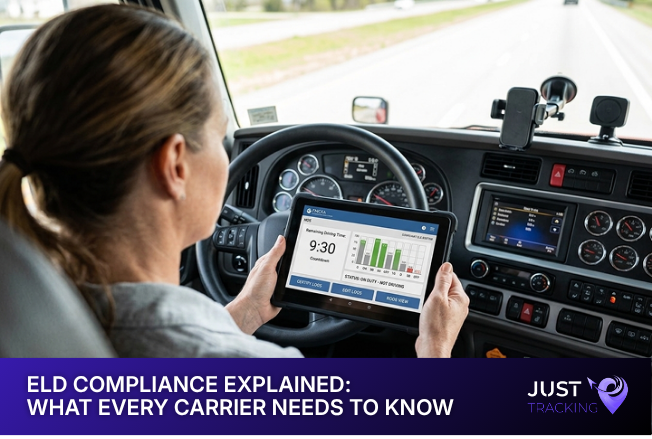
An ELD is a device connected to your truck that automatically records driving time. It tracks when the engine is running, how long the vehicle is moving, and how many hours a driver has been on duty.
In simple terms:
It replaces paper logs and makes sure drivers follow Hours of Service (HOS) rules.
Why Was the ELD Mandate Introduced?
The goal was straightforward reduce fatigue-related accidents and make logbooks harder to manipulate.
And it’s working, at least to some extent.
- The FMCSA reports millions of roadside inspections every year
- Hours-of-service violations still rank among the top driver violations, but enforcement is now much stricter
- Digital logs are far more consistent and harder to falsify than paper ones
For regulators, it’s about safety.
For carriers, it quickly became about something else: accountability and visibility.
What Happens If You’re Not Compliant?
Non-compliance doesn’t just mean a warning. It can lead to:
- Fines that can reach thousands of dollars per violation
- Drivers being placed out of service on the spot
- Higher CSA scores, which affect your reputation
- Increased insurance premiums
And insurance companies are paying attention more than ever. Fleets with poor compliance histories are often seen as high-risk and priced accordingly.
The Basics You Can’t Ignore
To stay compliant, a few things have to be in place:
- A registered ELD device (not all devices qualify)
- Drivers who know how to use it properly
- Logs that are accurate and certified daily
- Records stored for at least 6 months
- The ability to transfer logs during inspections
It sounds simple, but in reality, most violations happen because of small mistakes, not big ones.

Where Carriers Usually Slip Up
After talking to fleets and looking at inspection data, the same issues come up again and again.
1. Drivers aren’t fully trained
A lot of drivers learn ELDs on the go. That leads to:
- Wrong duty status
- Missed logs
- Confusion during inspections
2. Nobody checks the data
Installing an ELD isn’t enough. If no one reviews logs regularly, problems pile up quietly.
3. Unassigned driving time
This is a big one.
If miles aren’t assigned to a driver, it raises red flags instantly during audits.
4. Using ELDs as a “compliance-only” tool
This is probably the biggest missed opportunity.
Because the truth is that ELDs generate valuable data. Most fleets just don’t use it.
The Opportunity Most Carriers Miss
Here’s where things get interesting.
ELDs don’t just track hours. They show:
- Idle time
- Route efficiency
- Delays
- Driver behavior
- Real-time location
When you connect that data to a platform like Just Tracking, it stops being just a compliance tool.
It becomes part of how you run your business.
What That Looks Like in Real Life
Instead of switching between apps, paperwork, and phone calls, everything starts to connect.
- Dispatch knows where trucks are without calling drivers
- Customers get accurate ETAs
- Drivers spend less time dealing with admin work
- You spot inefficiencies you didn’t even know existed
Some fleets report cutting “where are you?” calls by more than half just by having proper tracking in place.
ELD Compliance by the Numbers
A few stats that show how important this really is:
- 3+ million roadside inspections conducted annually
- HOS violations remain a top driver-related issue
- Non-compliant fleets can face 20–40% higher insurance costs
These aren’t edge cases, they’re everyday realities in the industry.