Learn how freight brokers can prevent double brokering in 2026 with carrier verification, real-time tracking, fraud detection, and secure freight workflows.
The carrier has active operating authority. The insurance certificate looks legitimate. The dispatcher answers the phone, accepts the rate, and confirms the pickup appointment.
Everything appears to be in order.
Then, a truck belonging to a completely different company arrives at the shipper. The driver has a rate confirmation from another broker, the original dispatcher stops answering, and suddenly nobody can explain who is actually responsible for the freight.
For many freight brokers, this is how double brokering begins. Not with an obvious warning sign, but with a transaction that looks remarkably ordinary.
The problem has become more complicated in 2026. Fraudsters are no longer relying solely on fake MC numbers or poorly edited insurance certificates. They are impersonating legitimate trucking companies, compromising established carrier accounts, manipulating shipping documents, and exploiting the speed at which freight is booked on the spot market.
Preventing double brokering now requires more than checking a carrier's authority before sending a rate confirmation. It requires knowing who is moving the freight, maintaining control over the shipment, and recognizing when something in the transaction no longer adds up.
What Is Double Brokering in Trucking?
Double brokering occurs when a freight shipment is assigned to one party, which then transfers the transportation arrangement to another party without the necessary authorization, disclosure, or legal authority.
In a typical scenario, a freight broker contracts with a motor carrier to transport a load. Instead of hauling the freight as agreed, that carrier passes the shipment to another carrier, often without informing the original broker.
The company that actually moves the freight may have no idea that the shipment has been improperly rebrokered.
There are several ways this can play out.
An unauthorized intermediary might accept a load for $3,000, find another carrier willing to move it for $2,500, and pocket the $500 difference. In a more serious scheme, the intermediary collects payment from the original broker and disappears without paying the actual carrier.
In the worst cases, double brokering becomes part of a cargo theft operation. A criminal uses a stolen carrier identity to secure a shipment, hires an unsuspecting trucking company to collect it, and redirects the freight to an unauthorized location.
The common problem across these scenarios is that the original broker loses visibility into who is transporting the shipment and who controls its movement.
Double Brokering vs. Co-Brokering: What Is the Difference?
Not every transaction involving multiple brokers or transportation providers is fraudulent.
Legitimate co-brokering arrangements can involve two properly authorized freight brokers working together under an appropriate agreement. The parties understand their responsibilities, the arrangement is disclosed as required, and the shipment is handled according to the applicable contracts and regulations.
Unauthorized double brokering is different. It involves concealed or improper arrangements, often accompanied by misrepresentation, contractual violations, or a lack of required brokerage authority.
The distinction matters because freight brokers should not automatically assume that every third-party involvement is criminal. They should establish whether the arrangement is authorized, properly documented, and legally compliant.
Under 49 U.S.C. § 14916, interstate brokerage generally requires appropriate registration and financial security. The statute provides for civil penalties of up to $10,000 per violation, along with liability for valid claims incurred by injured parties.
Having motor carrier authority alone does not automatically authorize a company to conduct independent freight brokerage operations.
Why Double Brokering Is a Bigger Concern in 2026
Freight fraud has changed considerably over the past several years. What was once frequently associated with unauthorized intermediaries looking to collect a margin has become part of a broader ecosystem of identity theft, cybercrime, payment fraud, and organized cargo theft.
The numbers illustrate the scale of the problem.
In an April 2026 public service announcement, the FBI reported that estimated cargo theft losses across the United States and Canada reached nearly $725 million in 2025, representing a 60% increase compared with 2024.
The same announcement reported:
- An 18% increase in confirmed cargo theft incidents.
- A 36% increase in the average value of stolen shipments.
- An average theft value of $273,990.
These figures cover cargo theft broadly, not double brokering alone. However, the FBI specifically identified fraudulent rebrokering and compromised carrier identities as methods used in sophisticated cargo theft schemes.
Source: FBI Internet Crime Complaint Center — Cyber-Enabled Strategic Cargo Theft Surging, April 2026.
The gap between the increase in incident frequency and the increase in financial losses is particularly revealing.
The number of confirmed theft incidents rose by 18%, but estimated losses increased by 60%. This suggests that the financial severity of cargo crime is growing considerably faster than the number of reported incidents.
Criminals are not simply targeting more shipments. They are becoming more selective about which shipments they target.
A 2026 report published by Munich Re Specialty in partnership with BSI found that approximately 30% of U.S. cargo theft incidents in its 2025 data were strategic or fraud-driven. The report also found that 22% of cargo theft incidents globally involved insider participation.
Source: Munich Re Specialty — Cargo Theft Tactics and Trends Report 2026.
For freight brokers, these findings point to an uncomfortable reality: a shipment does not need to disappear from a parking lot to be stolen. It can be handed directly to the wrong person through an apparently legitimate business transaction.
How Double Brokering Actually Happens
Understanding the mechanics of double brokering is essential because many prevention strategies focus on the wrong part of the transaction.
Consider a hypothetical shipment of consumer electronics moving from California to Texas.
A broker posts the load for $4,200. A dispatcher representing a carrier with established operating authority contacts the brokerage and accepts the shipment.
The broker reviews the carrier's paperwork, confirms that the authority is active, and sends the rate confirmation.
But the dispatcher is not actually employed by that carrier. The carrier's identity has been compromised.
The fraudulent dispatcher then posts the same shipment elsewhere, offering $4,700 to another trucking company. A legitimate carrier accepts the higher-paying load and arrives at the shipper.
The driver receives modified shipping instructions and is eventually directed to deliver the freight to a different warehouse.
By the time the original broker realizes the shipment is not heading to its intended destination, the cargo may already have been transferred to another vehicle.
This example illustrates why a fraudulent intermediary may offer the actual carrier more money than the original broker agreed to pay.
The criminal is not necessarily trying to make a profit on the freight rate. The cargo itself may be the target.
The Five Stages of a Double Brokering Scheme
StageWhat happensWhat the broker should verifyCarrier impersonationA fraudulent party presents legitimate or stolen carrier credentialsIdentity and independently verified contact informationLoad acceptanceThe shipment is booked under the apparent carrier's authorityWho is accepting the shipment and under whose authorityUnauthorized reassignmentThe shipment is offered to another transportation providerActual driver, tractor, trailer, and carrier relationshipPickup and movementAn unexpected carrier collects or transports the freightPhysical pickup details and ongoing shipment visibilityPayment or delivery fraudFunds are diverted, the actual carrier remains unpaid, or cargo is redirectedDelivery confirmation, payment identity, and authorized instructions
The important point is that the fraud can survive an initial carrier verification check.
A legitimate MC number proves that a registered business exists. It does not prove that the person emailing your brokerage is authorized to represent that business.
10 Ways Freight Brokers Can Prevent Double Brokering in 2026
1. Verify Carrier Identity, Not Just Operating Authority
Carrier verification should begin with the Federal Motor Carrier Safety Administration's official records.
Use the FMCSA SAFER Company Snapshot and the agency's Licensing and Insurance system to review relevant company information, operating authority, insurance filings, and registration details.
But do not stop there.
An active authority and valid USDOT number establish that a carrier is registered. They do not authenticate the individual attempting to book your shipment.
If a dispatcher contacts you using a telephone number that differs from the carrier's independently established business number, call the verified number and confirm the relationship.
Ask whether the individual works for the carrier and whether the company has accepted the specific shipment.
Pay particular attention to recently changed contact information, unfamiliar email addresses, inconsistencies in company names, and discrepancies between onboarding documents and public records.
FMCSA recommends independently confirming carrier and broker telephone numbers and exercising caution when the information provided does not match its records.
Source: FMCSA — Broker and Carrier Fraud and Identity Theft.
However, even an FMCSA-listed telephone number should not be treated as infallible. The FBI's 2026 warning describes criminals manipulating carrier contact information in official records after compromising legitimate businesses.
For unfamiliar carriers or sensitive shipments, use more than one independent source to establish identity.
2. Treat Recent Changes in Carrier Information as a Risk Signal
A carrier that has operated for ten years is not necessarily safer than a carrier that received its authority six months ago.
Established authorities can be stolen, compromised, or misused. In fact, their operating history can make them attractive to criminals because brokers may be less likely to question them.
A more useful question is: Has anything about this carrier changed recently?
Look for changes involving:
- Business telephone numbers or email addresses.
- Company ownership or management.
- Mailing or physical addresses.
- Insurance providers or coverage details.
- Payment instructions and factoring relationships.
- The equipment or commodities the carrier claims to handle.
None of these changes automatically proves fraudulent activity. Legitimate trucking businesses update their information all the time.
The risk increases when several changes appear together or when the carrier cannot provide a consistent explanation.
For example, an established dry van carrier that suddenly begins accepting high-value refrigerated shipments, uses a new email domain, and requests payment to an unfamiliar account deserves additional scrutiny.
Carrier verification should be an ongoing process, not a one-time onboarding event.
3. Confirm Who Will Physically Pick Up the Load
One of the most effective ways to reduce double brokering risk is to connect the booking process to the actual truck and driver.
Before pickup, establish the identity of the motor carrier responsible for the shipment and confirm the assigned driver and equipment.
Depending on the shipment and your security procedures, this may include:
- Driver name and verified contact information.
- Tractor and trailer identification.
- License plate information.
- The USDOT number displayed on the vehicle.
- Confirmation that the driver is operating under the contracted carrier's authority.
The shipper should receive the relevant pickup details before the truck arrives.
If the truck that arrives belongs to an unexpected carrier, the discrepancy should be resolved before the freight is released.
FMCSA specifically recommends maintaining driver and vehicle records and comparing the equipment arriving at pickup with the contracted carrier's information.
A mismatch does not always mean fraud. Owner-operators, leased equipment, and legitimate carrier arrangements can create differences in vehicle ownership or registration.
What matters is whether the relationship can be verified and whether the transportation arrangement complies with the contract.
The loading dock is one of the last opportunities to prevent an unauthorized party from taking possession of the freight. Treat it accordingly.
4. Use Real-Time Shipment Tracking as a Verification Layer
Many freight brokers use tracking primarily to provide estimated arrival times and shipment updates to customers.
That is useful, but tracking can also support fraud prevention.
A shipment with reliable location visibility is easier to monitor for unexpected stops, unexplained delays, route deviations, or changes in delivery direction.
Suppose a load is booked from Atlanta to Dallas, but the truck begins moving toward a warehouse in a completely different region. That discrepancy may have an innocent explanation, but it should prompt immediate investigation.
Real-time tracking can help brokers identify:
- Whether the assigned driver has reached the pickup location.
- Whether the shipment is moving along the expected route.
- Whether the truck has stopped at an unexpected facility.
- Whether tracking becomes unavailable during a critical part of the trip.
- Whether the driver's reported location is consistent with shipment progress.
Tracking should be connected to the verified driver and shipment whenever possible.
A location link by itself is not proof that the person being tracked has the freight. Location data can be manipulated, and a tracked device may be separated from the actual cargo.
For higher-risk shipments, consider combining driver-based tracking with additional security measures, such as independent cargo tracking, seal verification, or direct facility confirmation.
The goal is not simply to see a dot moving on a map. It is to maintain confidence that the correct shipment remains under the control of the authorized transportation provider.
5. Stop Allowing Unverified Changes to Pickup or Delivery Instructions
Fraudsters frequently exploit the moments when a shipment changes hands or when delivery instructions are modified.
A broker receives a message saying the original warehouse cannot accept the shipment. A dispatcher provides a new address. A driver is instructed to make an additional stop.
These requests are not unusual in logistics, which makes them particularly useful to criminals.
Establish a clear procedure for approving changes to shipment instructions.
Any change involving the delivery address, consignee, carrier, driver, or transfer location should be verified through an established communication channel.
Do not approve a new delivery location solely because an email appears to come from the shipper or customer.
Call an independently verified contact and confirm the request.
Document who authorized the change, when it was approved, and why it was necessary.
For high-value shipments, consider requiring approval from a second authorized employee.
This procedure is especially important for cross-docking and transloading. Once freight is transferred to another vehicle, recovering visibility and establishing responsibility becomes significantly more difficult.
6. Keep Carrier Communication in Traceable Channels
Freight brokerage moves quickly. Dispatchers communicate by telephone, email, text message, and messaging applications throughout the day.
There is nothing inherently wrong with using different communication methods. The problem arises when critical shipment instructions become scattered across channels that cannot be independently verified or reviewed.
Imagine trying to investigate a missing load when the rate confirmation is in one employee's email, the driver's information is in a text message, the delivery change was communicated by telephone, and the dispatcher has deleted their messaging account.
A traceable communication history makes it easier to detect inconsistencies and reconstruct events.
Whenever possible, keep important shipment communication associated with the relevant load or trip record.
This includes rate confirmations, driver assignments, pickup instructions, delivery changes, supporting documents, and operational messages.
The 2025 cargo theft report published by TT Club and BSI in 2026 highlights the risks associated with fragmented freight communication and recommends maintaining controlled, auditable communication channels.
For brokers, the practical lesson is simple: if an important decision changes the movement of freight, that decision should be documented somewhere the brokerage can retrieve it.
7. Protect Your Brokerage Against Phishing and Account Takeovers
A compromised email account can undermine even a well-designed carrier verification process.
The FBI's April 2026 warning describes criminals using fraudulent emails, fake carrier agreement links, malicious websites, and compromised load board accounts to gain access to legitimate transportation businesses.
Once inside an account, criminals can communicate using an established company identity, publish fraudulent loads, or obtain sensitive shipment information.
The emails may look familiar because they are coming from an account your brokerage has worked with before.
This is why cybersecurity belongs in a freight broker's fraud prevention strategy.
Start with basic but essential controls:
- Require multifactor authentication for email, load board, and transportation management accounts.
- Use unique passwords and a business password manager.
- Limit employee access according to their responsibilities.
- Train employees to recognize suspicious links and unexpected document requests.
- Establish procedures for reporting suspected account compromises.
- Review unusual account activity and unexpected changes to login or payment information.
Employees should be particularly cautious when asked to download unfamiliar software to complete carrier onboarding, review documents, or access a rate confirmation.
If an unexpected email requests an urgent action, verify the request independently rather than replying directly to the message.
The objective is to prevent a legitimate company identity from becoming a tool for freight fraud.
8. Strengthen Broker-Carrier Agreements and Payment Controls
A clear broker-carrier agreement cannot physically prevent a criminal from stealing freight, but it can establish responsibilities and provide a stronger framework for responding to unauthorized transportation arrangements.
Your agreement should address unauthorized rebrokering, subcontracting, carrier responsibilities, shipment visibility, insurance obligations, and notification requirements.
Consider reviewing the following with qualified transportation counsel:
- Restrictions on unauthorized rebrokering or reassignment.
- Requirements for written approval of third-party transportation arrangements.
- Responsibility for maintaining appropriate operating authority and insurance.
- Procedures for reporting shipment irregularities.
- Documentation and payment requirements.
- Remedies for contractual violations.
Payment verification deserves particular attention.
Before releasing payment, confirm that the invoicing party is consistent with the authorized transportation arrangement and that any factoring or payment assignment has been independently verified.
Treat last-minute bank account changes as a separate fraud risk.
A request to redirect payment should not be approved simply because it comes from a familiar email address.
Contact the established company or factoring provider using previously verified information.
When a shipment is suspected of being double brokered, do not automatically assume that the actual carrier participated knowingly. Payment obligations can be legally complex, particularly when multiple parties claim compensation.
Work with legal counsel and your insurer to establish the appropriate response.
9. Build a Carrier Risk Assessment Instead of Relying on a Single Rule
Many brokerages adopt simple rules such as refusing to work with carriers whose authority is less than 90 days old.
Such rules may reduce exposure to certain schemes, but they can also create a false sense of security.
A carrier with five years of operating history may still have a compromised identity. A new carrier may be a legitimate owner-operator building a business.
A more balanced approach evaluates several independent risk factors together.
The following is an illustrative framework a brokerage could adapt to its own operations.
Risk factorSuggested responseNewly established carrier with limited operating historyAdditional verification before bookingRecent changes to contact or ownership informationIndependent identity confirmationUnfamiliar email domain or inconsistent telephone numberVerify through established company contactsEquipment inconsistent with the shipmentConfirm physical capability and assigned vehicleUnexpected pickup carrier or driverHold release until the discrepancy is resolvedUnverified delivery changeStop and obtain authorizationSudden payment account changeIndependently verify before payment
This is not a statistically validated fraud scoring model. It is a practical starting point for building consistent internal review procedures.
The most useful risk assessment systems distinguish between signals that require additional verification and events that require an immediate stop.
An unfamiliar email address may warrant investigation. A driver arriving under an unrelated carrier's authority without a verifiable explanation should prevent freight release until the issue is resolved.
10. Develop Direct Relationships With Carriers and Drivers
Freight fraud thrives when transportation providers are treated as interchangeable entries in a database.
A broker who books every shipment with an unfamiliar carrier under time pressure has fewer opportunities to recognize unusual behavior.
A broker who has established relationships with carriers, understands their equipment, knows their normal operating regions, and communicates directly with verified representatives has more context.
That context matters.
If a carrier you regularly work with suddenly uses a different dispatcher, changes its payment instructions, and sends an unfamiliar truck, you are more likely to notice.
Building a reliable carrier network does not mean avoiding the spot market. It means maintaining a history of the companies and drivers you work with and using that history to support future decisions.
A strong carrier relationship is not a substitute for verification. It makes verification more informed.
The Financial Cost of Double Brokering: More Than a Lost Freight Payment
When freight brokers evaluate fraud prevention, they often focus on the immediate cost of a stolen shipment or duplicate carrier payment.
The real exposure can be much broader.
Consider an illustrative shipment involving $150,000 worth of cargo.
The broker has agreed to pay the contracted carrier $3,000. The shipment is improperly rebrokered, the cargo is redirected, and the original intermediary disappears.
The brokerage may now face several separate financial consequences.
Potential exposureIllustrative amountCargo value$150,000Disputed freight payment$3,000Investigation and recovery expenses$5,000Replacement transportation$4,000Legal and claims-handling expenses$10,000Total potential exposure$172,000
These figures are hypothetical and are not an industry average. Actual liability, insurance recovery, and expenses depend on the facts, contracts, and applicable coverage.
The example demonstrates why the freight rate is a poor measure of the potential financial consequences of a compromised shipment.
A $3,000 transportation transaction can create exposure many times greater than the brokerage's expected margin.
There are also costs that are harder to quantify: lost shipper relationships, increased insurance premiums, damaged reputation, operational disruption, and the time employees spend investigating an incident instead of moving freight.
This is why fraud prevention should be treated as part of the brokerage's financial strategy, not merely as an administrative compliance requirement.
How to Measure Whether Your Fraud Prevention Strategy Is Working
Freight brokers already track revenue, gross margin, load volume, on-time delivery, and carrier performance.
Fraud prevention deserves its own operational metrics.
A brokerage that records only confirmed fraud incidents may miss the early warning signs that its controls are becoming less effective.
Consider tracking these six indicators.
Carrier Verification Completion Rate
What percentage of newly onboarded carriers complete all required verification steps before receiving their first shipment?
A low completion rate may indicate that employees are bypassing procedures to book freight faster.
Pickup Identity Mismatch Rate
How frequently does the carrier, driver, or equipment arriving at pickup differ from the approved shipment information?
Track both resolved and unresolved discrepancies. Not every mismatch is fraudulent, but recurring patterns can reveal weaknesses in booking or pickup procedures.
Unverified Shipment Change Requests
How often do brokers receive requests to change delivery addresses, carrier assignments, or transfer locations that cannot be immediately authenticated?
This metric can reveal emerging fraud attempts even when no shipment is lost.
Tracking Coverage
What percentage of shipments have reliable location visibility from pickup through delivery?
Measure coverage against your actual security requirements rather than simply counting how many tracking links were sent.
Fraud Losses per 1,000 Loads
Calculate confirmed fraud-related financial losses relative to shipment volume.
This makes it easier to compare performance over time, even when the brokerage grows.
Time to Detect and Respond
How much time passes between the first suspicious event and the brokerage's intervention?
A business that identifies a compromised shipment before pickup is in a much stronger position than one that discovers the problem after an unauthorized delivery.
These metrics should be reviewed together.
A rise in reported suspicious incidents does not necessarily mean fraud prevention is failing. It may indicate that employees are becoming better at recognizing and documenting warning signs.
The objective is to reduce successful fraud and financial losses while improving detection.
What Should a Freight Broker Do if Double Brokering Is Suspected?
The first priority is to establish the location of the freight and determine who currently has possession of it.
If the shipment has not been collected, stop its release until the carrier identity and transportation arrangement can be verified.
If the freight is already moving, contact the actual driver or carrier through an independently verified channel. Confirm the shipment's location, current instructions, and intended destination.
Preserve all relevant documentation, including rate confirmations, bills of lading, emails, messages, telephone records, tracking information, insurance documents, and payment instructions.
Notify the shipper and other relevant parties according to your contractual obligations and incident response procedures.
If cargo theft or identity fraud is suspected, contact law enforcement and your insurer promptly.
Depending on the circumstances, incidents may also be reported through:
- FBI Internet Crime Complaint Center
- FMCSA National Consumer Complaint Database
- U.S. Department of Transportation Office of Inspector General
Do not attempt to resolve a suspected theft by confronting individuals at an unfamiliar location or instructing a driver to take unsafe action.
Also, avoid treating the carrier physically transporting the shipment as automatically responsible for the fraud.
As FMCSA explains:
“The carrier, who had or has your load, may also be a victim.”
The actual carrier may have accepted what appeared to be a legitimate shipment and may be just as exposed as the original broker.
Establishing cooperation between the parties can be critical to recovering the freight and resolving the incident.
How Just Tracking Helps Brokers Maintain Better Freight Visibility
Preventing double brokering requires more than a single technology platform. Carrier verification, cybersecurity, contractual controls, pickup procedures, and employee training all remain essential.
However, freight visibility can help brokers maintain better control over the operational side of a shipment.
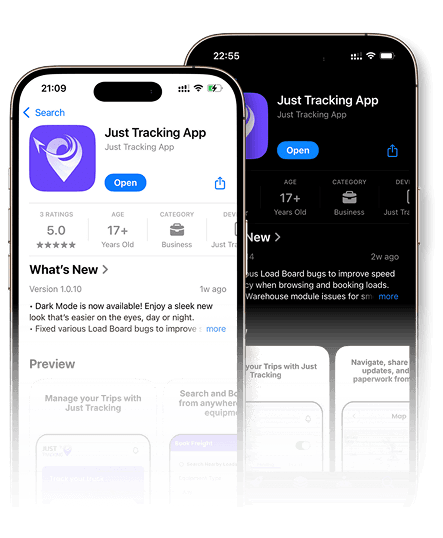
Just Tracking brings several freight management and communication capabilities into one platform.
Find and Connect With Drivers
The Live Drivers feature allows users to discover available drivers who have chosen to share their location and availability.
Brokers can view relevant equipment and contact information, helping them establish direct communication with potential transportation providers.
This can support more informed carrier relationships, although it does not replace independent carrier verification.
Maintain Shipment Visibility
Just Tracking's trip management and tracking capabilities allow shipment progress to be monitored from pickup through delivery.
Users can share tracking links and communicate shipment updates, helping reduce uncertainty about where a truck is and how a trip is progressing.
Keep Shipment Communication Connected
Load-related messaging, trip notes, and document-sharing capabilities help keep operational information associated with the relevant shipment.
When a discrepancy occurs, having shipment information organized in one place can make it easier to review what happened.
Build More Consistent Freight Workflows
A combination of direct communication, organized shipment information, and real-time visibility can help brokers reduce reliance on fragmented telephone calls and disconnected messages.
These tools do not guarantee that a carrier is legitimate or that a shipment cannot be compromised.
Their value lies in helping transportation professionals maintain visibility, communication, and operational control throughout the freight movement.
For brokers, knowing who is handling a shipment and being able to follow its progress should be part of everyday operations, not something that begins only when a problem occurs.
Frequently Asked Questions About Double Brokering
Is double brokering illegal?
Unauthorized brokerage can violate federal law, particularly when an entity provides interstate brokerage services without the required registration and financial security. Double brokering may also involve contractual violations, fraud, identity theft, or other unlawful conduct.
Legitimate, properly authorized co-brokering arrangements are not automatically illegal.
How can a freight broker identify a double broker?
There is no single reliable indicator. Warning signs include inconsistent carrier contact information, unexpected pickup carriers, unauthorized shipment transfers, suspicious delivery changes, and payment requests that cannot be independently verified.
Brokers should investigate multiple indicators rather than relying on one piece of information.
Can a carrier with active operating authority double broker a load?
Yes. Active motor carrier authority does not establish that a particular transaction is authorized or that the person arranging it is a legitimate representative of the carrier.
Criminals can also use stolen or compromised carrier identities.
Does cargo insurance protect brokers from double brokering?
Not necessarily. Insurance coverage depends on the policy wording, the insured parties, the circumstances of the loss, and applicable exclusions.
Fraud, voluntary parting, cyber-related incidents, and unauthorized transportation arrangements may raise complex coverage questions.
Brokers should review these exposures with their insurance professionals before an incident occurs.
Can GPS tracking prevent double brokering?
GPS tracking can improve shipment visibility and help identify unexpected movement or route deviations, but it cannot independently verify carrier identity or guarantee that freight has not been transferred to another party.
It is most effective when combined with carrier verification, pickup controls, and secure communication.
What is the difference between double brokering and cargo theft?
Double brokering involves an unauthorized or improper reassignment of freight transportation. Cargo theft involves the unlawful taking of goods.
Some double brokering schemes are designed to divert freight payments, while others are used to facilitate cargo theft.
The two problems can overlap, but they are not identical.
Should freight brokers avoid newly authorized carriers?
Not automatically. New operating authority can be one factor in a broader risk assessment, but it is not proof of fraudulent activity.
Established carrier identities can also be compromised. Brokers should evaluate identity, equipment, insurance, operating history, communication, and shipment-specific risks together.
Final Thoughts
The most dangerous double brokering scheme is not necessarily the one with obviously fraudulent paperwork. It is the one that looks like a routine freight transaction until the shipment is already in the wrong hands.
That is why freight brokers need to move beyond a verification process that ends when a carrier's MC number is approved.
Carrier identity must be confirmed. The actual truck and driver must be connected to the shipment. Changes to transportation instructions must be authenticated. Freight movement must remain visible, and critical decisions must be documented.
No individual measure can eliminate double brokering entirely.
But a brokerage that maintains control over these points is considerably better positioned to detect suspicious activity before it becomes a financial loss.
In 2026, the question is no longer simply whether a carrier has the authority to move a load.
It is whether the broker can establish who is actually moving it, where it is going, and who has the authority to change those instructions.
The better a brokerage can answer those questions, the harder it becomes for fraud to hide inside an otherwise ordinary shipment.
Find transportation partners, maintain shipment visibility, and keep freight communication connected with Just Tracking.