Protect your trucking authority from bad data. Learn how the FMCSA's updated CSA scores directly impact your broker relationships, insurance premiums, and roadside inspections. Discover actionable strategies to keep your compliance categories clean and your trucks moving profitably.
If you own or manage a trucking company, you already know that your operation is constantly judged by a set of numbers you can't afford to ignore. We aren’t talking about your profit margins, your loaded mile ratios, or your fuel mileage, we are talking about your CSA scores.
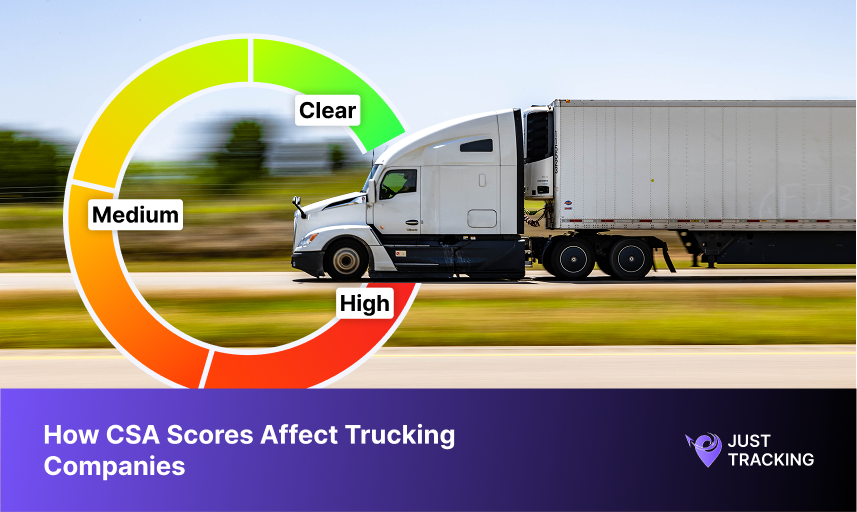
Run by the Federal Motor Carrier Safety Administration (FMCSA), the Compliance, Safety, Accountability (CSA) program calculates a rolling, 24-month percentile rank for your fleet. Measured on a scale from 0 to 100, the baseline rule is simple: zero is perfect, and 100 means your operation is in serious jeopardy.
Historically, fleets viewed these safety metrics as an administrative headache to deal with during annual audits. But today, the FMCSA has shifted to a data-heavy, real-time enforcement approach. With structural overhauls to the Safety Measurement System (SMS) taking full effect, including reorganized compliance categories, consolidated violation codes, and tighter intervention thresholds your safety data has teeth.
Let’s take a look at how these scores impact your trucking business, and what you need to do to protect your bottom line.
1. The Freight Lockout: Why Brokers and Shippers Are Watching
The most immediate damage caused by a spiking CSA score comes from the load boards.
Brokers and premium shippers rely heavily on your ISS (Inspection Selection System) score, which is directly pulled from your underlying CSA data. If your percentile climbs past the FMCSA’s intervention thresholds, your company is flagged with a mandatory "Inspect" or "Optional" recommendation.
A bad safety score is a silent killer for a carrier. The tier-one automotive and retail shippers won't even let a truck into their yards if the carrier has an active alert in their safety profile. You're immediately locked out of the most profitable lanes.
When you are flagged, risk management departments at major brokerages automatically pull your authority from their approved carriers list to shield themselves from negligent selection lawsuits. You are instantly relegated to cheap, spot-market freight, squeezing your margins when you need cash flow the most.
2. The Financial Squeeze: Insurance Rates and Roadside Audits
If your safety metrics are slipping, your overhead will inevitably skyrocket in two distinct ways:
Sky-High Insurance Premiums
Underwriters look at your vehicle maintenance and unsafe driving history the exact same way a bank looks at a bad credit score. A fleet operating above intervention thresholds can easily face premium increases of 20% to 50% year-over-year. For a small to mid-sized fleet, that extra expense can mean the difference between staying profitable or parking your equipment for good.
The Target on Your Back
When a state trooper scales your truck and runs your DOT number, your CSA score determines how meticulously they will look at your equipment. High scores trigger continuous roadside inspections and targeted compliance reviews.
Furthermore, the updated framework streamlines the math. The agency has consolidated thousands of messy violation codes into roughly 100 clean behavioral groups, meaning out-of-service orders now penalize you heavily under simplified severity weights.
The CSA Breakdown: What Triggers Intervention?
The system tracks your fleet across critical safety behaviors:
- Unsafe Driving: Speeding, reckless lane changes, and a failure to wear seatbelts. Under recent updates, this now completely absorbs all controlled substance and alcohol violations, alongside any operation of a vehicle while under an Out-of-Service order.
- Vehicle Maintenance: Split into "Driver Observed" (the things that should be caught on a Level 2 walk-around pre-trip) and deep mechanical issues discovered during Level 1 shop teardowns.
- HOS Compliance: Driven heavily by electronic logging device (ELD) data accuracy. With modern data retention rules requiring ELD providers to hold logs for years, spotting historic patterns of fatigue or log manipulation is easier than ever for auditors.
3. The Proactive Plan: How to Lower the Score
Reversing a downward trend in your safety profile requires an active operational strategy. Because recent inspections carry the heaviest mathematical weight, you can rapidly improve your standing by focusing on clear, immediate fixes.
Clean Inspections ➔ Dilutes Historic Points ➔ Lowers Percentile ➔ Drops Insurance Rates
Enforce the Pre-Trip Challenge
Vehicle maintenance accounts for the vast majority of easy roadside citations. Implement strict, mandatory walk-around procedures focusing heavily on lighting, tire tread depth, and brake stroke measurements. Catching a chafed air brake hose in your yard costs $20; catching it at a weigh station costs you massive CSA points and an out-of-service delay.
Utilize the Clean Inspection Boost
The fastest way to burn off bad historical points is to pile up clean inspections. Encourage your clean, compliant drivers to pull into open weigh stations when they know their equipment is flawless. A string of violation-free Level 1 or Level 2 reports will dilute your older infractions, pulling your percentile rank back down toward safety.
Run a Clean Tech Stack
Paperwork slip-ups, missing driver qualification files, and unverified medical certs are entirely preventable errors that trigger costly compliance audits. Modern carriers protect themselves by unifying their operations. When you run your dispatches, routing, and compliance alerts through an integrated system like Just Tracking, you eliminate the manual tracking errors that invite DOT intervention. You keep your fleet organized, your logs clean, and your trucks rolling past the weigh stations without the stress of a surprise inspection.
The Bottom Line
Your CSA score is your company’s public safety resume. Brokers use it to rate you, insurance companies use it to price you, and enforcement officers use it to target you.
Take care of your drivers, hold them accountable to clean pre-trips, and back your business up with data-driven tracking tools that keep you ahead of the regulatory curve.