Maximize your RPM with our 2026 Freight Market Report. Analyze the highest-demand U.S. shipping lanes, from Laredo’s nearshoring surge to the Midwest tech corridor. Access essential industry analytics, spot rate trends, and professional logistics insights to optimize your fleet’s profitability in today’s tightening market.
The freight market of 2026 isn’t the chaotic "wild west" of the post-pandemic years, but it’s certainly not "business as usual" either. After a long, bruising downcycle that saw thousands of small carriers exit the market, the pendulum is finally swinging back.
We are currently in a supply-driven transition. Capacity is leaner, driver availability is tightening at the fastest pace in three years, and "nearshoring" has officially turned the traditional U.S. freight map on its head.
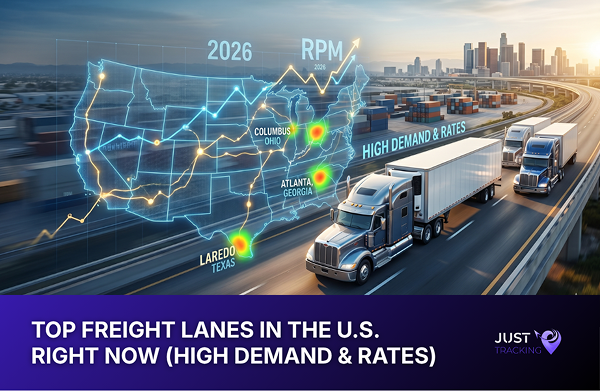
If you’re looking to maximize your RPM (Rate Per Mile) and minimize deadhead, here are the top freight lanes in the U.S. right now, backed by the latest 2026 data.
1. The "Nearshoring" King: Laredo to Dallas–Fort Worth (DFW)
As manufacturing shifts from Asia to Mexico, the Laredo–DFW corridor has become the most consistent high-volume lane in the country.
- The Draw: Massive volume in automotive parts, electronics, and industrial components.
- The Stats: DFW operating costs are nearly 23% lower than coastal hubs like Los Angeles, yet the outbound volume remains relentless.
- Expert Insight: "In 2026, the DFW hub isn't just a Texas stop; it’s the primary inland port for North America. If you aren't positioned to catch the Mexico-to-Midwest flow, you’re leaving money on the table."
2. The Southeast Gatekeeper: Atlanta to Charlotte
The Southeast continues to lead the nation in population growth, and that translates directly into consumer demand. Atlanta remains the "North Star" of the South, but the Atlanta–Charlotte lane is currently seeing a surge in "last-mile" replenishment freight.
- Current Trend: Spot rates in the Southeast have seen a 5.2% year-over-year increase as of early 2026.
- Why it works: Short-haul, high-frequency runs. You can often "double-dip" this lane, getting a reload back to Atlanta within the same 14-hour clock.
3. The Tech Triangle: Columbus to Chicago
Columbus, Ohio, is the "sleeper hit" of 2026. Thanks to massive investments in semiconductor plants and EV battery "gigafactories," the Columbus–Chicago lane has evolved from a simple retail route into a high-value industrial corridor.
- The Fact: Chicago remains the only city where all six Class I railroads meet, making the intermodal-to-truck handoff here incredibly lucrative.
- The Analytics: While national manufacturing has been spotty, high-tech freight in the "Ohio-Indiana-Michigan triangle" is outperforming the national average by 12% in volume growth.
4. The Refrigerated Powerhouse: Central Valley to Seattle
For Reefer operators, the West Coast is seeing a tight capacity crunch. As older equipment is retired due to stricter 2026 emissions regulations, those who have compliant reefer units are seeing a premium on the California–Pacific Northwest run.
- Reefer Outlook: Reefer spot rates are projected to hit a 5% peak growth by Q3 2026.
- The Catch: This lane is high-reward but high-cost. Fuel price volatility—driven by Middle East tensions—hits West Coast lanes harder due to already high state taxes.
Strategic Advice for Shippers & Carriers
For Carriers: Chase the Loop, Not the Rate
A $4.00/mile load is a trap if it lands you in a "dead zone" like Florida or the Pacific Northwest without a backhaul. In 2026, the most profitable operators are those running "triangular" routes.
- Example: Laredo → Dallas → Memphis → Laredo. This keeps the wheels turning and avoids the dreaded $0.00/mile deadhead.
For Shippers: Resilience over Cost
The era of the "lowest bidder" is fading. With tender rejections on the rise, shippers are shifting toward cost visibility.
"Cost predictability in 2026 is more valuable than a 10-cent savings today that results in a failed pickup tomorrow."
Final Thoughts
The U.S. freight market isn't in a "boom" yet, but it’s no longer in a "bust." It’s a skill-based market. Success right now comes from lane selection and cost control. Whether you're hauling semiconductor components out of Ohio or produce out of Laredo, the data is clear: the most consistent money is moving through the middle of the country and across the Southern border.